
I remember the exact moment the doctor sat back, looked at my bloodwork, and said the words: “Your A1C is 5.9. You have prediabetes.”
It felt like a flashing yellow traffic light. I wasn’t in the danger zone of full-blown type 2 diabetes yet, but I was speeding toward it. My mind immediately went to a dark place of restriction. Goodbye, flavor. Goodbye, joy. Hello, cardboard food.
But here is the truth I discovered over the next twelve months: a prediabetes diagnosis isn’t a life sentence to a boring kitchen. It is a powerful, rare second chance. It’s a wake-up call that your metabolism is struggling, but it’s still fully capable of fighting back. I managed to pull my numbers back into the healthy range, and I didn’t do it by starving myself. I did it by changing my relationship with food.
If you’ve just received this diagnosis, take a deep breath. Let’s talk about how to rewrite your script using a practical, flavor-first prediabetes diet strategy.
1. Ditching the “All-or-Nothing” Trap
When I first got home from the clinic, I went full scorched-earth. I threw out everything in my pantry that looked like a carbohydrate. By day four, I was exhausted, cranky, and staring longingly at a box of crackers.
The lesson? Extreme restriction backfires.
Instead of cutting out carbs entirely, the secret lies in understanding the Glycemic Index (GI)—essentially, how fast a food turns into sugar in your bloodstream. You don’t need to give up carbohydrates; you just need to upgrade them.
The Swap: I stopped buying instant white rice and white bread (high-GI foods that spike your blood sugar like a rocket). Instead, I fell in love with steel-cut oats, quinoa, and nutty black rice (low-GI foods that slowly simmer into your system, keeping your energy stable for hours).
2. The “Crowding Out” Method (The Anti-Diet Strategy)
Psychologically, being told what you can’t eat makes you want it more. So, I flipped the script. I stopped focusing on what to subtract and focused entirely on what to add. I call it “crowding out.”
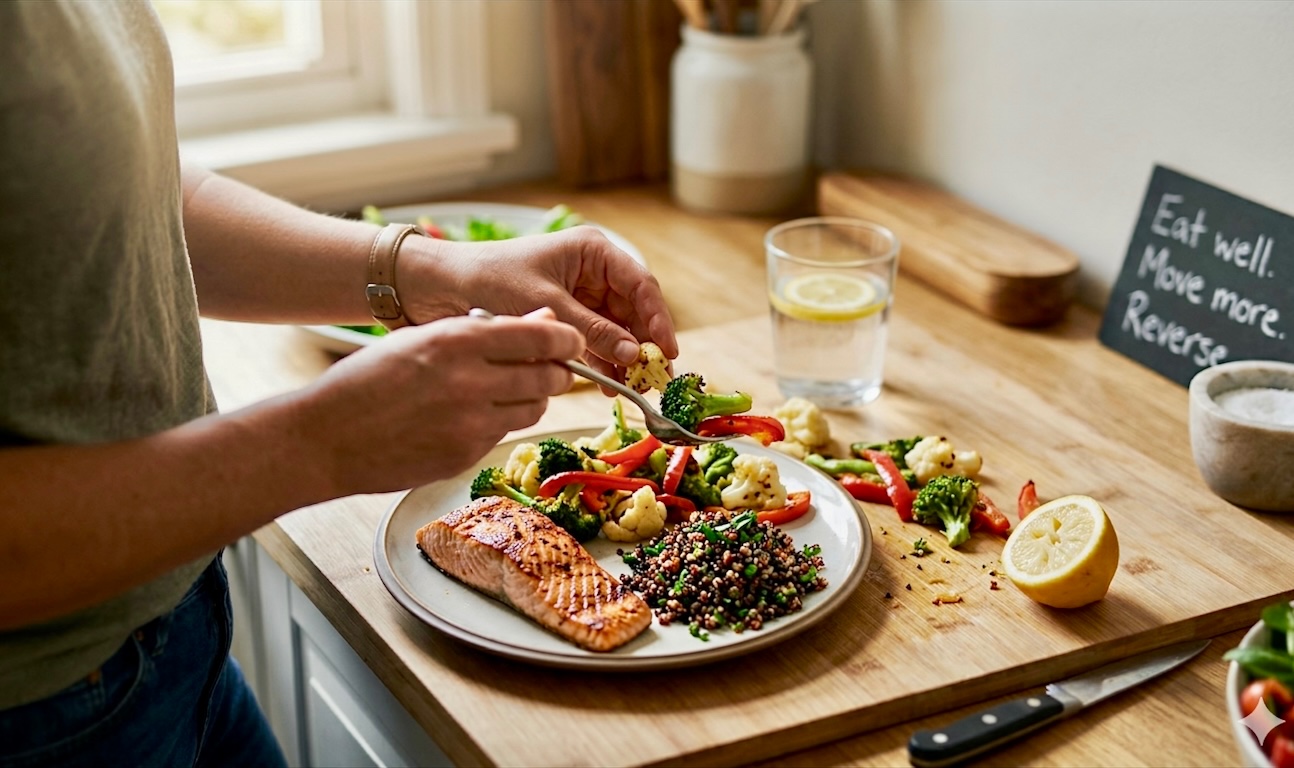
I adopted the American Diabetes Association’s Plate Method, but with a personal rule: fill the plate with the good stuff first so there’s physically less room for the blood-sugar spikes.
Every lunch and dinner, I challenged myself to cover half my plate in colorful, non-starchy vegetables (roasted Brussels sprouts, garlic-sauteed spinach, crunchy salads). By the time I ate my fiber and my protein (like wild-caught salmon or grilled tofu), I only had room for a small, controlled portion of complex carbs. I felt full, satisfied, and my insulin levels didn’t have to work overtime.
3. The Unsung Hero: Soluble Fiber
If there is a magic wand in the prediabetes world, it’s dietary fiber. Think of fiber as a gentle sponge in your digestive tract. It slows down the absorption of sugar, ensuring your pancreas isn’t hit with a sudden tidal wave of glucose.
I started gamifying my fiber intake, aiming for roughly 30 grams a day.
I threw a tablespoon of chia seeds into my morning yogurt.
I swapped potato chips for roasted chickpeas dusted with smoked paprika.
I kept a jar of almonds and walnuts on my desk for afternoon slumps.
The result? The mid-afternoon energy crashes that used to send me sprinting to the vending machine completely vanished.
4. The Liquid Audit
The easiest, most painless victory of my entire journey came down to what I was drinking. I used to think a morning glass of orange juice or a flavored latte was harmless. It wasn’t. Liquid sugars hit your bloodstream instantly because there is no fiber to slow them down.
My Golden Rule: Eat your fruit, don’t drink it.
I swapped the morning juice for a whole orange (hello, fiber!). I traded sodas for sparkling water infused with fresh lime and mint. Within three weeks of cutting out liquid sugars, my morning fasting blood glucose numbers began to steadily drop.
The Takeaway: Your Body Wants to Heal
Reversing prediabetes isn’t about achieving perfection; it’s about creating consistency. When you pair a fiber-rich, balanced diet with just 20–30 minutes of daily movement—like a brisk post-dinner walk—your muscle cells naturally start waking up and pulling sugar out of your blood.
Receiving a prediabetes diagnosis is a turning point. You can look at it as the beginning of a disease, or you can choose to see it as the moment you took control of your health. Your body wants to find its balance again. You just have to give it the right fuel to get there.
Disclaimer: I am sharing my personal journey and research-backed nutritional strategies. Because everyone’s metabolism is unique, it is vital to work alongside a registered dietitian or healthcare professional to tailor a plan specific to your body’s needsI swapped the morning juice for a whole orange (hello, fiber!). I traded sodas for sparkling water infused with fresh lime and mint. Within three weeks of cutting out liquid sugars, my morning fasting blood glucose numbers began to steadily drop.